
.png)

 Contact
 Focus and Scope
 Editorial Team
 Reviewer
 Peer Review Process
 Publication Ethics
 Author Fees
 Screening For Plagiarism
 Indexing Sites
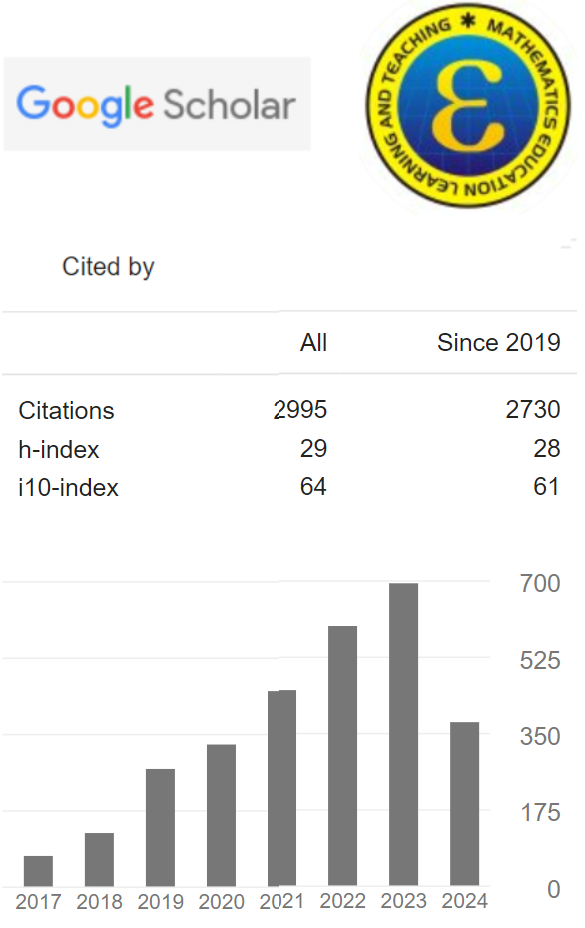
  Citedness in Scopus
 Statistics of Visitors
 Copyright Notice
 Journal History


Inductive reasoning skills: Identification of student errors using APOS theory
(1) Universitas Pendidikan Indonesia
(2) Universitas Islam Riau
(3) Universitas Islam Riau
(*) Corresponding Author
Abstract
Keywords
Full Text:
PDFReferences
Agustyaningrum, N., Abadi, A. M., Sari, R. N., & Mahmudi, A. (2018). An Analysis of Students’ Error in Solving Abstract Algebra Tasks. Journal of Physics: Conference Series, 1097(1). https://doi.org/10.1088/1742-6596/1097/1/012118
Agustyaningrum, N., Hanggara, Y., Husna, A., Abadi, A. M., & Mahmudii, A. (2019). An analysis of students’ mathematical reasoning ability on abstract algebra course. International Journal of Scientific and Technology Research, 8(12), 2800–2805.
Andamon, J. C., & Tan, D. A. (2018). Conceptual understanding, attitude and performance in mathematics of Grade 7 Students. International Journal of Scientific and Technology Research, 7(8), 96–105.
Arnon, I., Cottrill, J., Dubinsky, E., Oktaç, A., Solange, Fuentes, R., Trigueros, M., & Weller, K. (2014). APOS Theory: A Framework for Research and Curriculum Development in Mathematics Education. Springer. https://doi.org/10.1007/978-1-4614-7966-6
Atmowardoyo, H. (2018). Research Methods in TEFL Studies: Descriptive Research, Case Study, Error Analysis, and R & D. Journal of Language Teaching and Research, 9(1), 197. https://doi.org/10.17507/jltr.0901.25
Bakar, R. (2018). The influence of professional teachers on Padang vocational school students’ achievement. Kasetsart Journal of Social Sciences, 39(1), 67–72. https://doi.org/10.1016/j.kjss.2017.12.017
Banamtuan, J. D., Gella, N. J. M., & Babys, U. (2022). Analysis of Student’s Error Concept in Solving Questions on The Rank Material. International Journal Of Humanities Education and Social Sciences (IJHESS), 1(5), 679–687. https://doi.org/10.55227/ijhess.v1i5.140
Barton, B. (1996). Ethnomathematics: Exploring Cultural Diversity in Mathematics. American Ethnologist, 21(4), 922–923. http://doi.wiley.com/10.1525/ae.1994.21.4.02a00380
Bhat, M. A. (2016). The Predictive Power of Reasoning Ability on Academic Achievement. International Journal of Learning, Teaching and Educational Research, 15(1), 79–88.
Buetow, S. (2014). How can a family resemblances approach help to typify qualitative research? Exploring the complexity of simplicity. SAGE Open, 4(4). https://doi.org/10.1177/2158244014556604
Corcoran, R., & Frith, C. D. (2005). Thematic Reasoning and Theory of Mind. Accounting for Social Inference Difficulties in Schizophrenia. Evolutionary Psychology, 3(1), 147470490500300. https://doi.org/10.1177/147470490500300101
Davis, J. (2018). Extending Behavioral Economics’ Methodological Critique of Rational Choice Theory. Journal of Behavioral Economics for Policy, 2(2), 5–9.
Ding, C. S., Song, K., & Ricahrdson, L. I. (2006). Do Mathematical Gender Differences Continue? A Longitudinal Study of Gender Difference and Excellence in Mathematics Performance in the U.S. Educational Studies, 40(3), 279–295. https://doi.org/10.1080/00131940701301952
Junpeng, P., Marwiang, M., Chiajunthuk, S., Suwannatrai, P., Chanayota, K., Pongboriboon, K., Tang, K. N., & Wilson, M. (2020). Validation of a digital tool for diagnosing mathematical proficiency. International Journal of Evaluation and Research in Education, 9(3), 665–674. https://doi.org/10.11591/ijere.v9i3.20503
Kantahan, S., Junpeng, P., Punturat, S., Tang, K. N., Gochyyev, P., & Wilson, M. (2020). Designing and verifying a tool for diagnosing scientific misconceptions in genetics topic. International Journal of Evaluation and Research in Education, 9(3), 564–571. https://doi.org/10.11591/ijere.v9i3.20544
Kazunga, C., & Bansilal, S. (2020). An APOS analysis of solving systems of equations using the inverse matrix method. Educational Studies in Mathematics, 103(3), 339–358. https://doi.org/10.1007/s10649-020-09935-6
Khan, L. A. (2015). What is Mathematics - an Overview. International Journal of Mathematics and Computational Science, 1(3), 98–101.
Khansa, N., Susanti, E., Indaryanti, Sari, N., & Simarmata, R. H. (2020). Mathematics reasoning through inquiry learning model. Journal of Physics: Conference Series, 1480(1). https://doi.org/10.1088/1742-6596/1480/1/012056
Kim, C. M., Belland, B. R., Baabdullah, A., Lee, E., Dinç, E., & Zhang, A. Y. (2021). An Ethnomethodological Study of Abductive Reasoning While Tinkering. AERA Open, 7(1), 1–25. https://doi.org/10.1177/23328584211008111
Lestari, & Jailani. (2018). Enhancing an Ability Mathematical Reasoning through Metacognitive Strategies. Journal of Physics: Conference Series, 1097(1). https://doi.org/10.1088/1742-6596/1097/1/012117
Lommatsch, C. W., & Packenham, P. S. (2019). Earning Logic: Examining the effects of context ordering on reasoning about conditionals. International Journal of Mathematical Education in Science and Technology, 51(5). https://doi.org/10.1080/0020739X.2019.1626502
Mastropasqua, T., Crupi, V., & Tentori, K. (2010). Broadening the study of inductive reasoning: Confirmation judgments with uncertain evidence. Memory and Cognition, 38(7), 941–950. https://doi.org/10.3758/MC.38.7.941
Mehadi, R. (2019). 21st Century Skill “Problem Solving”: Defining the Concept. Asian Journal of Interdisciplinary Research, 2(1), 71–81. https://doi.org/10.34256/ajir1917
Mercier, H., Boudry, M., Paglieri, F., & Trouche, E. (2017). Natural-Born Arguers: Teaching How to Make the Best of Our Reasoning Abilities. Educational Psychologist, 52(1), 1–16. https://doi.org/10.1080/00461520.2016.1207537
Muhammad, I., & Yolanda, F. (2022). Minat Belajar Siswa Terhadap Penggunaan Software Adobe Flash Cs6 Profesional Sebagai Media Pembelajaran. JIPM (Jurnal Ilmiah Pendidikan Matematika), 11(1), 1–12. https://doi.org/10.25273/jipm.v11i1.11083
Muin, A., Hanifah, S. H., & Diwidian, F. (2018). The effect of creative problem solving on students’ mathematical adaptive reasoning. Journal of Physics: Conference Series, 948(1). https://doi.org/10.1088/1742-6596/948/1/012001
Mukumbang, F. C., Kabongo, E. M., & Eastwood, J. G. (2021). Examining the Application of Retroductive Theorizing in Realist-Informed Studies. International Journal of Qualitative Methods, 20, 1–14. https://doi.org/10.1177/16094069211053516
Pahrudin, A., Ahid, N., Huda, S., Ardianti, N., Putra, F. G., Anggoro, B. S., & Joemsittiprasert, W. (2020). The effects of the ECIRR learning model on mathematical reasoning ability in the curriculum perspective 2013: Integration on student learning motivation. European Journal of Educational Research, 9(2), 675–685. https://doi.org/10.12973/eu-jer.9.2.675
Palinussa, A. L., Molle, J. S., & Gaspersz, M. (2021). Realistic mathematics education: Mathematical reasoning and communication skills in rural contexts. International Journal of Evaluation and Research in Education, 10(2), 522–534. https://doi.org/10.11591/ijere.v10i2.20640
Permendiknas. (2006). Permendiknas No. 22 Tahun 2006 Tentang Standar Isi.
Ponticell, S. J. Z. and J. A. (2019). The Wiley Handbooks in Education.
Quilang, L. J. L., & Lazaro, L. L. (2022). Mathematical connections made during investigative tasks in statistics and probability. International Journal of Evaluation and Research in Education, 11(1), 239–249. https://doi.org/10.11591/ijere.v11i1.21730
Retnawati, H., Arlinwibowo, J., Wulandari, N. F., & Pradani, R. G. (2018). Teachers’ difficulties and strategies in physics teaching and learning that applying mathematics. Journal of Baltic Science Education, 17(1), 120–135. https://doi.org/10.33225/jbse/18.17.120
Salgado, H., & Trigueros, M. (2015). Teaching eigenvalues and eigenvectors using models and APOS Theory. Journal of Mathematical Behavior, 39(September), 100–120. https://doi.org/10.1016/j.jmathb.2015.06.005
Seah, W. T., Zhang, Q., & Bishop, A. J. (2021). Mentors Expressing What They Value Through Their Writings: Emphasizing the Person in Mathematics. ECNU Review of Education, 4(2), 230–240. https://doi.org/10.1177/2096531120932173
Sidenvall, J., Lithner, J., & Jäder, J. (2015). Students’ reasoning in mathematics textbook task-solving. International Journal of Mathematical Education in Science and Technology, 46(4), 533–552. https://doi.org/10.1080/0020739X.2014.992986
Siyepu, S. W. (2015). Analysis of errors in derivatives of trigonometric functions. International Journal of STEM Education, 2(1). https://doi.org/10.1186/s40594-015-0029-5
Sosa-Moguel, L., & Aparicio-Landa, E. (2021). Secondary school mathematics teachers’ perceptions about inductive reasoning and their interpretation in teaching. Journal on Mathematics Education, 12(2), 239–256. https://doi.org/10.22342/JME.12.2.12863.239-256
Soysal, Y., & Soysal, S. (2022). Relationship Between a Teacher Educator’s Questions and the Development of Prospective Teachers’ Critical Thinking. ECNU Review of Education, 38, 209653112211070. https://doi.org/10.1177/20965311221107028
Stephens, R. G., Dunn, J. C., Hayes, B. K., & Kalish, M. L. (2020). A test of two processes: The effect of training on deductive and inductive reasoning. Cognition. https://doi.org/10.1016/j.cognition.2020.104223
Umam, K., & Susandi, D. (2022). Critical thinking skills: Error identifications on students’ with APOS theory. International Journal of Evaluation and Research in Education, 11(1), 182–192. https://doi.org/10.11591/ijere.v11i1.21171
Wahyuni, E. S., Susanto, & Hadi, A. F. (2019). Profile of the student’s mathematical reasoning ability in solving geometry problem. Journal of Physics: Conference Series, 1211(1). https://doi.org/10.1088/1742-6596/1211/1/012079
Wasiran, Y., & Andinasari. (2019). Mathematics Instructional Package Based on Creative Problem Solving to Improve Adaptive Reasoning Ability and Creative Thinking Ability. Journal of Physics: Conference Series, 1167(1). https://doi.org/10.1088/1742-6596/1167/1/012060
Weinhandl, R., Lavicza, Z., & Houghton, T. (2020). Mathematics and STEM teacher development for flipped education. Journal of Research in Innovative Teaching & Learning, 13(1), 3–25. https://doi.org/10.1108/jrit-01-2020-0006
Widiati, I., & Juandi, D. (2019). Philosophy of mathematics education for sustainable development. Journal of Physics: Conference Series, 1157(2). https://doi.org/10.1088/1742-6596/1157/2/022128
Winarso, W., & Toheri, T. (2021). An Analysis of Students’ Error in Learning Mathematical Problem Solving; the Perspective of David Kolb’s Theory. Turkish Journal of Computer and Mathematics Education (TURCOMAT), 12(1), 139–150. https://doi.org/10.16949/turkbilmat.753899
Wu, H., & Molnár, G. (2018). Interactive problem solving: Assessment and relations to combinatorial and inductive reasoning. Journal of Psychological and Educational Research, 26(1), 90–105.
Yadav, S. (2019). Role of Mathematics in the Development Of Society. International Journal of Research and Analytical Reviews (IJRAR), 6(4), 295–298.
Yanto, B. E., Subali, B., & Suyanto, S. (2019). Improving students’ scientific reasoning skills through the three levels of inquiry. International Journal of Instruction, 12(4), 689–704. https://doi.org/10.29333/iji.2019.12444a
Zuhri, M. S., & Purwosetiyono, F. D. (2019). Profil Kemampuan Penalaran Matematis Dalam Pemecahan Masalah Pada Mahasiswa Calon Guru Matematika. JIPMat, 4(1). https://doi.org/10.26877/jipmat.v4i1.3548
DOI: 10.24235/eduma.v14i1.17227
Article Metrics
Abstract view : 3 timesPDF - 1 times
Refbacks
- There are currently no refbacks.

Copyright (c) 2025 EduMa: Mathematics education learning and teaching
p>
\
bitstarz casino bonus codes